
Exercise bikes for home and commercial use
An exercise bike lets you improve your fitness comfortably, whatever the weather. Our range includes compact exercise bikes for home, precisely adjustable ergometers and commercial exercise bikes for intensive use.


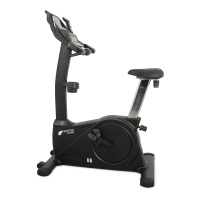
825,-

450,-

375,-
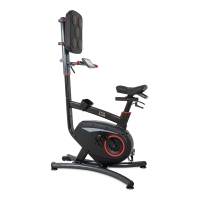
1899,-
What is an exercise bike?
An exercise bike is a stationary fitness bike for indoor cycling. You usually sit upright and choose your own pace and resistance. This makes it suitable for gentle exercise, building fitness, endurance workouts and more intensive cycling sessions.
Which muscles does an exercise bike work?
Cycling mainly works your quadriceps, hamstrings, calves and glutes. Your abdominal and back muscles help keep your upper body stable. Increasing the resistance makes pedalling harder, while a faster cadence challenges your cardiovascular fitness and endurance.
What is the difference between an exercise bike and an ergometer?
A bike ergometer measures your power output in watts. Models with a constant-watt programme automatically adjust the resistance to your pedalling speed to maintain the selected power output within their operating range. This allows targeted, repeatable workouts. A standard exercise bike usually uses resistance levels, without focusing on an exact wattage.
Which resistance system should you choose?
Many exercise bikes use magnetic resistance, with magnets moving closer to or further from the flywheel to change the resistance. An electromagnetic system controls the magnetic field electronically, allowing precise, automatic resistance adjustments during workout programmes.
Do not judge a bike solely by its flywheel weight. The drivetrain, bearings, frame construction and resistance system setup also influence how smoothly and evenly it pedals.
What should you look for when buying an exercise bike?
Compare the saddle and handlebar adjustments, maximum user weight and frame stability. You should be able to set the saddle height so that your knee remains slightly bent at the bottom of the pedal stroke. Horizontal saddle adjustment also helps you set a suitable distance to the handlebars.
Check the dimensions, step-through height and intended usage rating. A low step-through design can make getting on easier, but not every model has one. If you train frequently or several people will share the bike, choose a sturdier model with a wide range of adjustments.
Workout programmes and heart rate control
Workout programmes automatically vary the resistance to add variety to your sessions. Depending on the model, you can train towards a time, distance, calorie or wattage target, or follow a preset course profile. Heart rate control programmes, often labelled HRC, adjust the workout intensity based on your heart rate.
Some exercise bikes measure your heart rate using handlebar sensors or connect to a compatible chest strap. A chest strap generally provides a more consistent reading while cycling, as you do not need to keep your hands on fixed contact sensors.
Exercise bikes with training apps
Many modern exercise bikes connect to a smartphone or tablet via Bluetooth. Depending on the model's compatibility, this lets you use training apps for virtual routes, interactive workouts and tracking your results. Check which apps are supported and whether a subscription is required.
Upright exercise bike, indoor cycling bike or recumbent bike?
An upright exercise bike offers a relatively upright, comfortable riding position and suits a wide range of fitness levels. An indoor cycling bike usually has a sportier riding position and is geared more towards intensive cycling workouts. On a recumbent bike, you sit lower with backrest support for added comfort and stability.
Exercise bikes for home and commercial use
A compact home exercise bike may be sufficient for a few sessions a week. For frequent or intensive training, a heavier model with a stable frame and a rating for more demanding use is a better choice. Semi-commercial and commercial bikes are designed for shared use in settings such as personal training studios, workplace gyms, hotels, professional practices and fitness centres.
How do you compare riding position and comfort?
Riding position, pedal spacing, stability and pedalling smoothness vary between exercise bikes. Compare the saddle and handlebar adjustment ranges with your height and preferred posture, and check how easily you can reach the controls. Consider your training goals and expected frequency of use as well. Specifications help you compare models, but cannot fully describe how comfortable a bike will feel for you.
Exercise bikes are part of our complete range of cardio fitness equipment for training at home and in commercial fitness facilities.
